ServiceNow Data Sync - Groups
Once you have created a sync configuration, you can set how you'd like to synchronize groups between ServiceNow and xMatters.
 Enable group sync
For each configuration you can specify whether to sync users, groups, or both, however you must have at least one part of the sync (users or groups) enabled in order to run a sync.
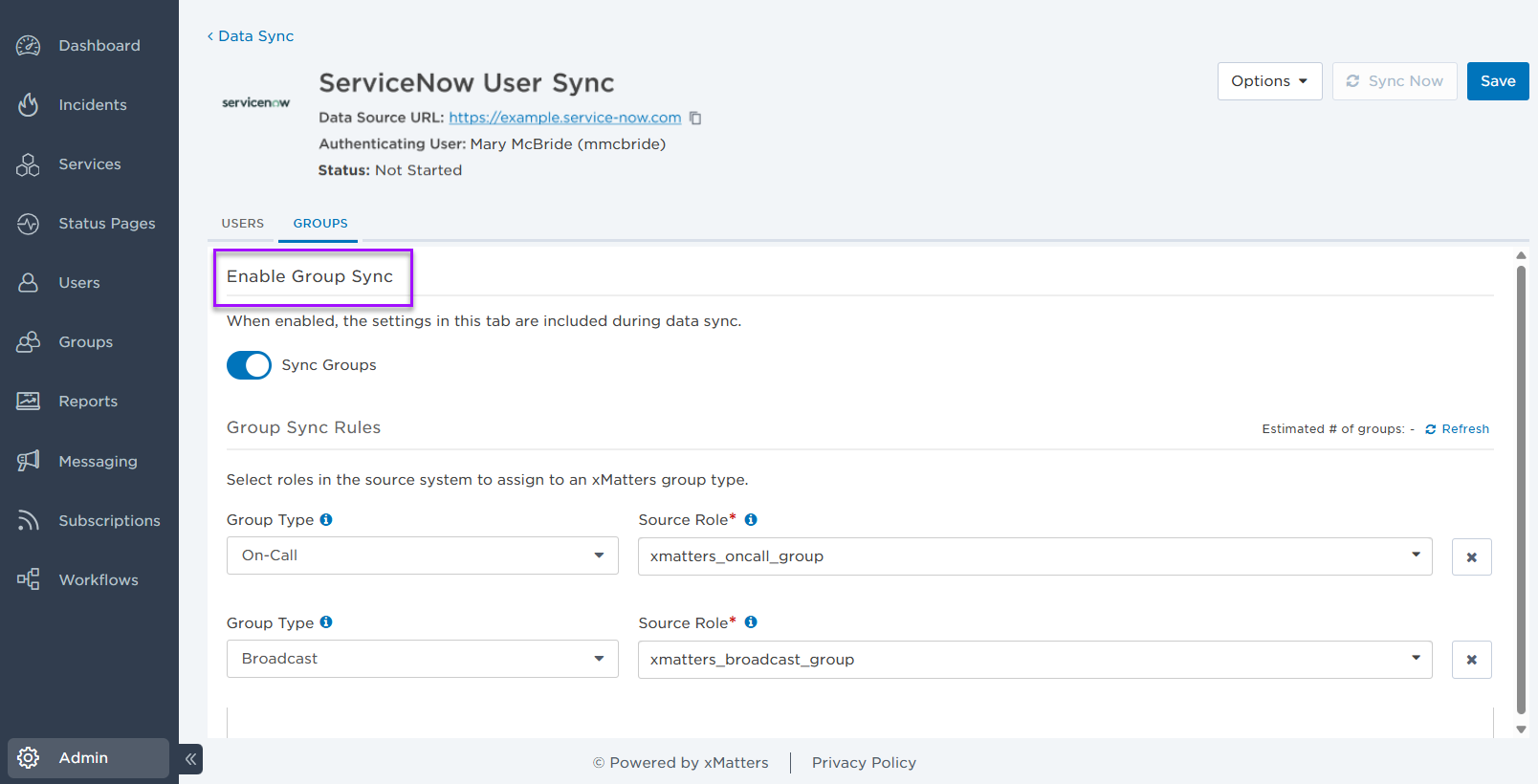
Set group mapping
Once you have created a new sync configuration, you can set which ServiceNow roles you want to map to each group type in xMatters. As you map values, you can see the estimated number of groups that will be synchronized between ServiceNow and xMatters. If you make changes to the sync rules, you can 'Refresh' to see the new the number of groups.
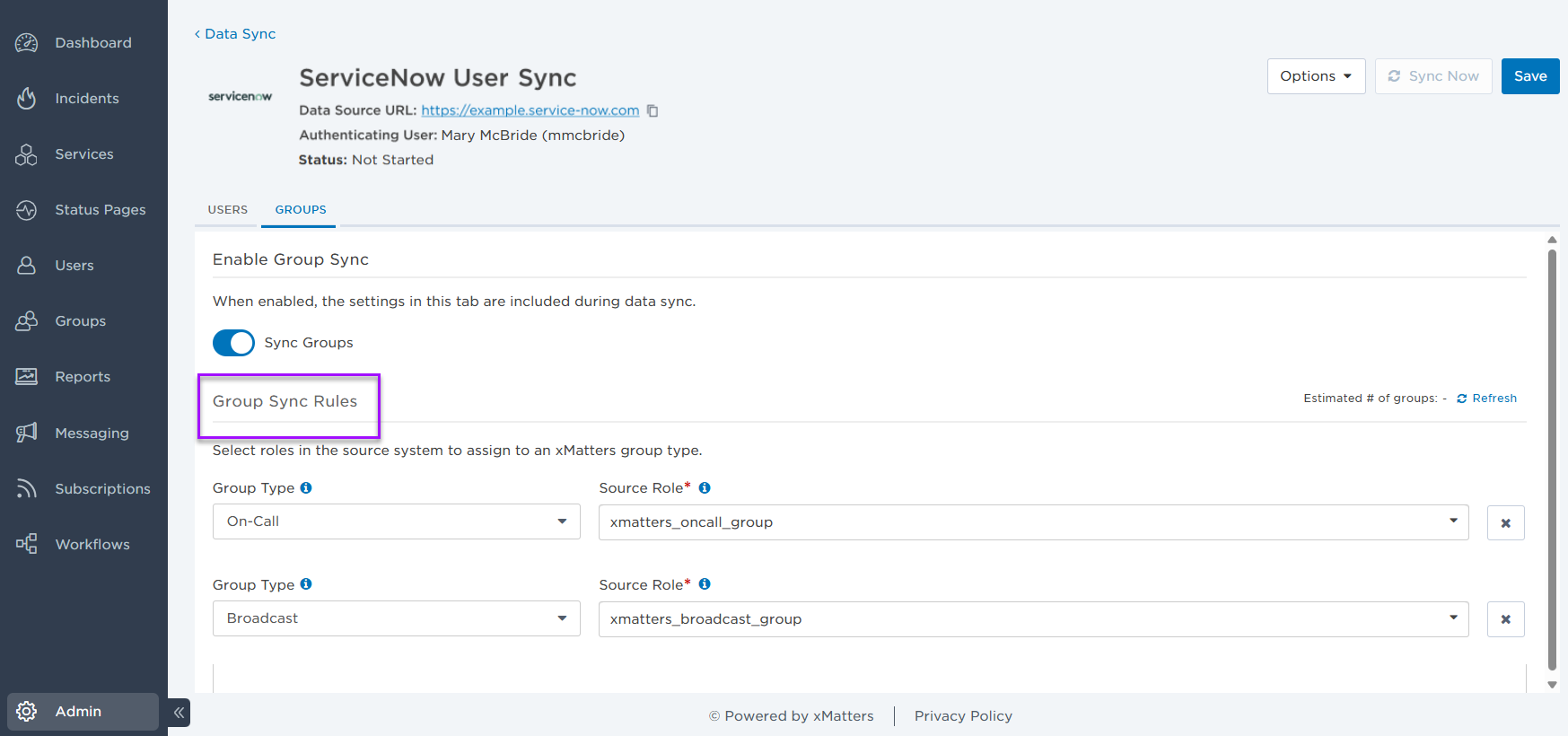
To add roles to a group type;
- In the Group Sync Rules section, expand the Group Type drop-down menu and select the group type. Available options are:
- On-Call
- Broadcast
- Expand the Source Role drop-down menu and select the ServiceNow roles to map to the group type.
- An xMatters group type can contain multiple ServiceNow roles, but a role can only be mapped to one group type. If a group matches criteria for both group types, the Broadcast group type takes precedence.
Now that the group types are mapped, you can map the group properties, including custom group properties.
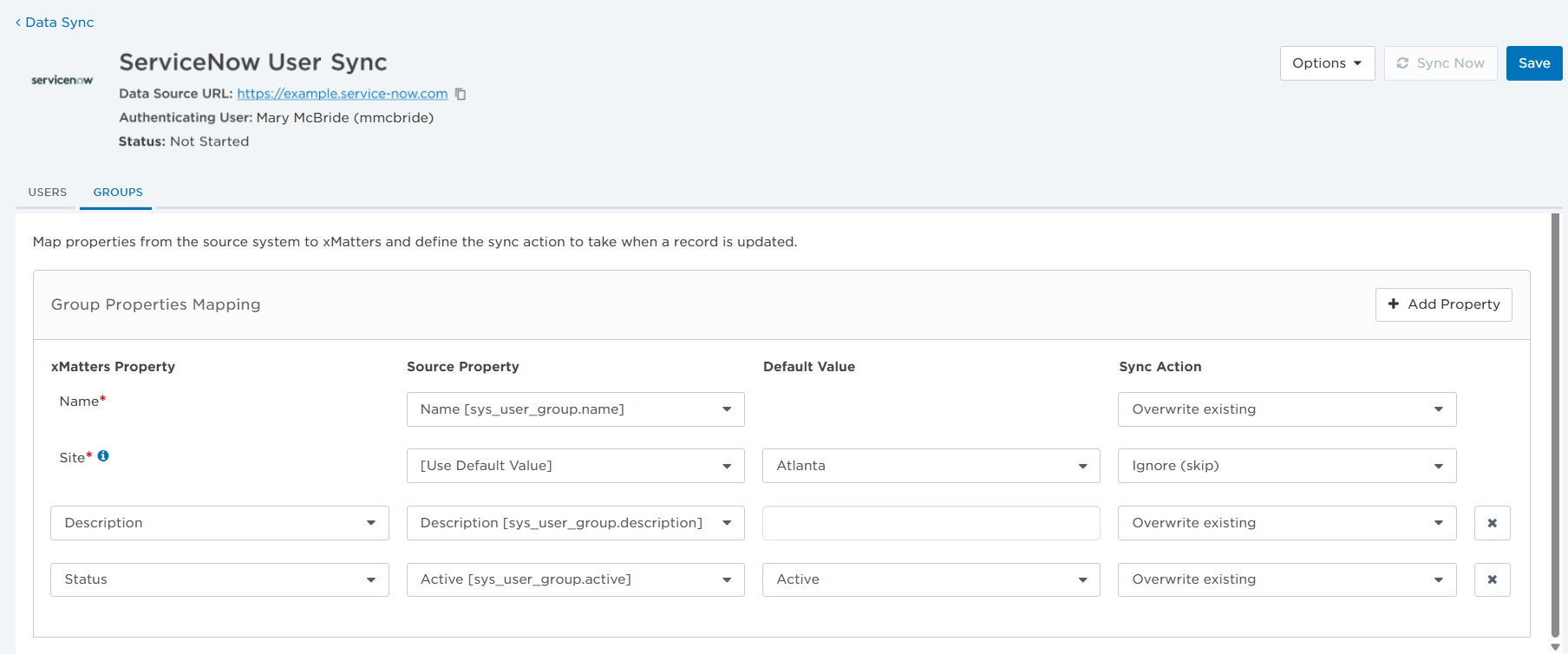
- In the Group Properties Mapping table, map source properties from ServiceNow to their corresponding xMatters properties.
- xMatters Property: Name of the property in xMatters.
- Source Property: Name of the property in ServiceNow. If the property has a default value, you can use that by selecting 'Use Default Value' from the drop-down menu.
- Default Value: The default value for the property, if there is one.
- Sync Action: What action to take for each property when a subsequent sync is run. During the initial sync the Sync Action setting is ignored. Available values are:
- Overwrite existing: Overwrite the existing property in xMatters with the property value from ServiceNow.
- Update if empty: Only update the field in xMatters if it was previously empty.
- Ignore (skip): Make no changes in xMatters.
- To map properties other than the listed default properties, click Add Property.
- Continue to the next configuration section or Save and run the sync.
Default shift settings
To help organize group members into shifts, you can create a default shift on an initial sync. All group members will be added to that shift on the initial sync. After the default shift is created, new members are added to the end of the default shift's escalation order on subsequent syncs.
If the synced group does not have a default shift, members are added to the group roster.
- Go to the Default Shift Settings section.
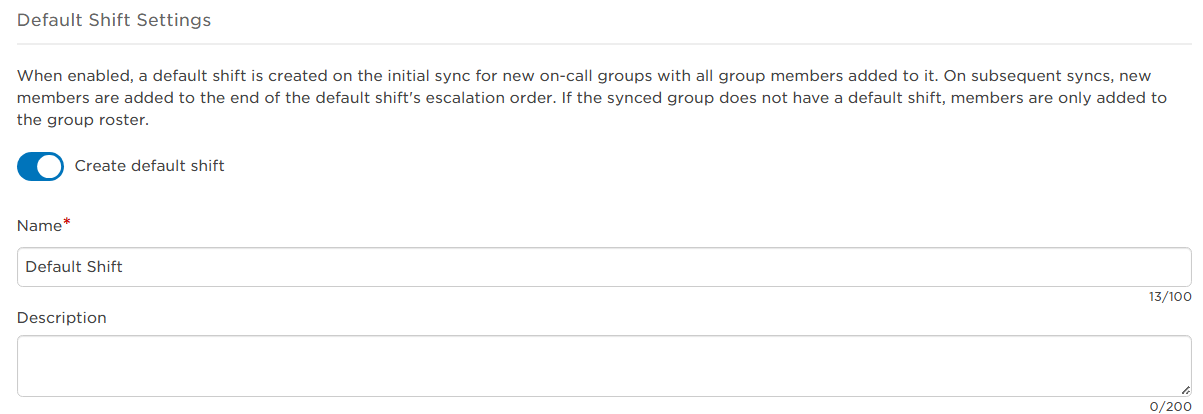
- Enable the 'Create default shift' toggle.
- Give the default shift a name and, optionally, a description.
- The shift name can have a maximum of 100 characters.
- The shift description can have a maximum of 200 characters.
- Save the sync.
Set group admins
Group administrators are set when a group is created during the initial sync with xMatters. Each group must have at least one admin specified on creation, but you can add or remove additional admins during subsequent syncs.
- Go to the Group Admin Sync Rules section.

- From the Assign Default Group Admins drop-down, select when default group admins are set. Available options are:
- Assign only default group admins: Only assign the specified users as default admins. The mapping table is hidden from view for this option.
- In addition to mapped value: Add the specified users as group admins in addition to the mapped values.
- Only if mapped value is invalid: Add the specified users as group admins only if the mapped value from the source system is invalid.
- In the Default Group Admins field, search for or enter the name of the xMatters user to set as the group administrator. The drop-down menu displays a list of users that are authorized to be group admins.
- In the Group Admins Mapping table, map source properties from ServiceNow to their corresponding xMatters properties.
- Source Property: Name of the property in ServiceNow. If the property has a default value, you can use that by selecting 'Use Default Value' from the drop-down menu.
- Sync Action: What action to take for each property when a subsequent sync is run. During the initial sync the Sync Action setting is ignored. Available values are:
- Overwrite existing: Overwrite the existing property in xMatters with the property value from ServiceNow.
- Update if empty: Only update the field in xMatters if it was previously empty.
- Ignore (skip): Make no changes in xMatters.
- Save the sync.
Run data sync
After a configuration is saved, click Sync Now to run the data sync.
Only one sync can be run at a time for each configuration and it can take several minutes for a sync to connect, then to complete. Once you click 'Sync Now', do not navigate away from the page, or click the 'Sync Now' button again.
When the sync is finished, you can click the Status link to view a summary report.
Schedule data sync
You can schedule syncs to run daily, weekly, or monthly to bring data in on a predictable schedule. The sync will run as close to the scheduled time as possible, but will not automatically adjust for Daylight Savings Time changes.
Data syncs cannot be scheduled if the configuration contains errors.
To schedule a sync:
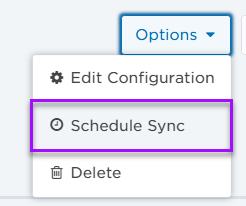
- From the Options menu, select Schedule Sync.
- On the Schedule Sync modal:
- Enable the 'Schedule Sync' toggle.
- Set the frequency and time.
- Set the Time Zone. The time zone of the authenticating user is used by default.
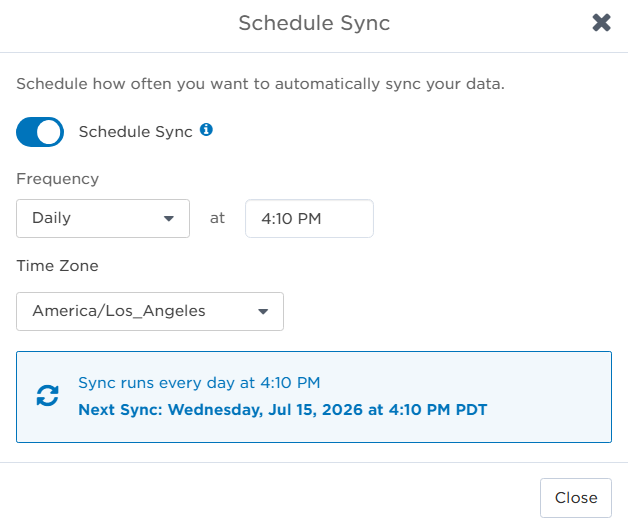
- Confirm the sync is accurately set using the blue info box, then click Close.
Once set, a reminder is displayed on the main sync configuration page.
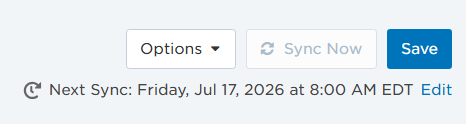
To disable a scheduled sync, click 'Edit' and disable the Schedule Sync toggle.
Edit configuration settings
You can make changes to an existing configuration if required. It is important to note that when configuration settings change, there may be mapping errors that require correction.
To edit the sync configuration:
- Go to the Options menu and select Edit Configuration.

- On the Edit Sync Configurations window, make the required changes.
- Click Save.
Once applied, any properties not compatible with the new configuration settings will be highlighted. To run a sync using the new configuration you must clear all mapping errors and save the configuration.
Delete configuration
If a sync configuration is no longer required, you can delete it to ensure it's not accidentally run. Deleting a sync removes the connection between xMatters and ServiceNow, but it does not delete any data brought into xMatters from previously run syncs.
To delete the sync configuration:
- Go to the Options menu and select Delete.

- Confirm the deletion.
The sync is deleted from the Sync Configurations page.